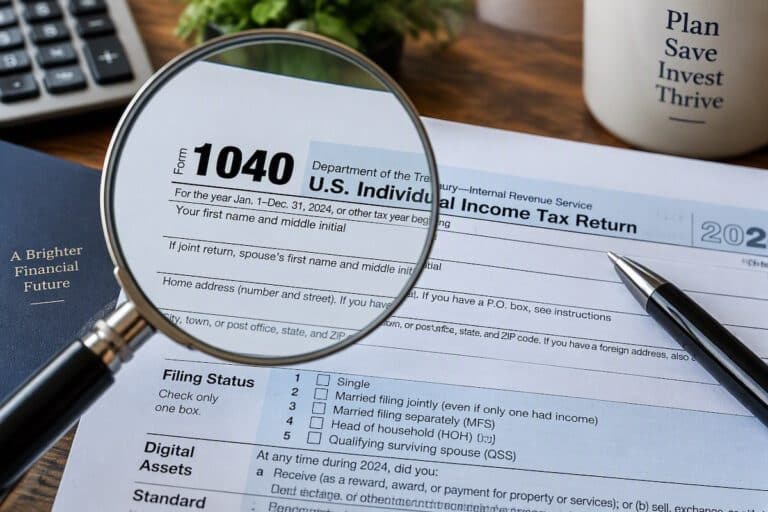
It is not what your investments earn that matters most. It is what they earn after taxes. Between federal income tax, capital gains tax, the net investment income tax, and New York State and local taxes, a meaningful share of your return can go to taxes each year if you are not paying attention.
Here is a simple illustration. A $50,000 investment earning 8% a year grows to about $107,946 after 10 years. If those earnings are taxed each year at 24%, the after-tax return drops to 6.08%, and the same investment grows to only about $90,220. That gap widens the longer you invest. (This is a hypothetical example that ignores fees and state taxes; it is not a prediction of any investment’s return.)
Here are five ways to keep more of what you earn.
1. Use tax-advantaged accounts first
Workplace plans and IRAs let your investments grow without annual taxes. For 2026, you can contribute up to $24,500 to a 401(k), 403(b), or 457 plan, plus $8,000 if you are 50 or older, or $11,250 if you are 60 to 63. You can also contribute up to $7,500 to an IRA, or $8,600 if you are 50 or older.
Traditional accounts give you a deduction now and tax the withdrawals later. Roth accounts give no deduction but offer tax-free qualified withdrawals. Having money in both types gives you more flexibility to manage your tax bracket in retirement. Withdrawals before age 59½ from these accounts may be subject to a 10% additional tax.
2. Put the right investments in the right accounts
Interest from bonds and CDs is taxed as ordinary income, at rates up to 37%. Qualified dividends and long-term capital gains (on investments held more than a year) are taxed at a top rate of 20%. Higher earners may also owe the 3.8% net investment income tax, which applies above $200,000 of modified adjusted gross income for single filers and $250,000 for married couples filing jointly.
Because of that difference, it often makes sense to hold interest-producing investments in tax-deferred accounts and to hold stocks you plan to keep for the long term in taxable accounts, where they can benefit from lower capital gains rates. Withdrawals from a traditional IRA or 401(k) are taxed as ordinary income, so holding a long-term stock position there can turn a capital gain into ordinary income.
3. Consider municipal and Treasury bonds
Interest on most municipal bonds is exempt from federal income tax, and bonds issued in your home state may also be exempt from state and local tax. That can be especially valuable for New York residents. Interest on U.S. Treasury securities is taxed federally but exempt from state and local tax.
To compare, calculate the taxable-equivalent yield. For someone in the 24% federal bracket, a municipal bond yielding 5% is equivalent to a taxable bond yielding about 6.58% (5% divided by 0.76), before state taxes. Because municipal bond interest is already tax-exempt, there is usually no reason to hold municipal bonds inside an IRA. Bonds sold before maturity or held in a fund can lose value, and income from certain private activity bonds may be subject to the alternative minimum tax.
4. Look for tax-efficient funds
Some mutual funds and ETFs generate much more in taxable distributions than others. Index funds and tax-managed funds tend to have lower turnover, which means fewer capital gains passed through to you each year. ETFs are often more tax-efficient than comparable mutual funds because of the way shares are created and redeemed. Be careful buying a mutual fund late in the year in a taxable account; you may receive a capital gains distribution for gains you didn’t participate in.
5. Put losses to work, and keep good records
Realized losses first offset realized gains. If losses are larger, you can deduct up to $3,000 a year against ordinary income and carry the rest forward. Harvesting losses can also be a good time to rebalance. If you sell at a loss, wait more than 30 days before buying the same or a substantially identical investment, or the loss will be disallowed under the wash sale rule.
Keep records of your purchases, reinvested dividends, and capital gains distributions so your cost basis is correct when you sell. Overlooking reinvested distributions is a common way people end up paying tax twice on the same money.
Taxes are one factor, not the only one
A good investment decision should come first, and tax efficiency second. Taxes should not keep you in an investment that no longer fits your plan. Reviewing your accounts together with your tax professional each year is the best way to find opportunities. For year-end ideas, see Lower Your Tax Bill with Year-End Planning.
Content in this material is for general information only and not intended to provide specific advice or recommendations for any individual.